The Provincial Government of Camarines Sur officially launched the Philippines' first Green Embankment Project and rolled out a localized Aksyon Kontra Baha on March 5, 2026, in the municipalities of Garchitorena and Milaor, respectively. The initiative is the country's first science-based, vegetative flood mitigation program, marking a significant step toward nature-driven coastal and river protection.
Governor Luis Raymund “Lray” Villafuerte, Jr., together with Congressman Luigi Villafuerte, spearheaded the launching, following extensive research into sustainable alternatives to conventional flood control infrastructure. Drawing on models implemented and proven effective in Japan, the program employs natural coastal vegetation to absorb and deflect the impact of strong waves and storm surges generated by typhoons.
“This (green embankment) is already being done in Japan, and we will do it here. Green embankments will provide additional protection while also beautifying the area,” the Governor said.
Green embankment: Nature as the first line of defense
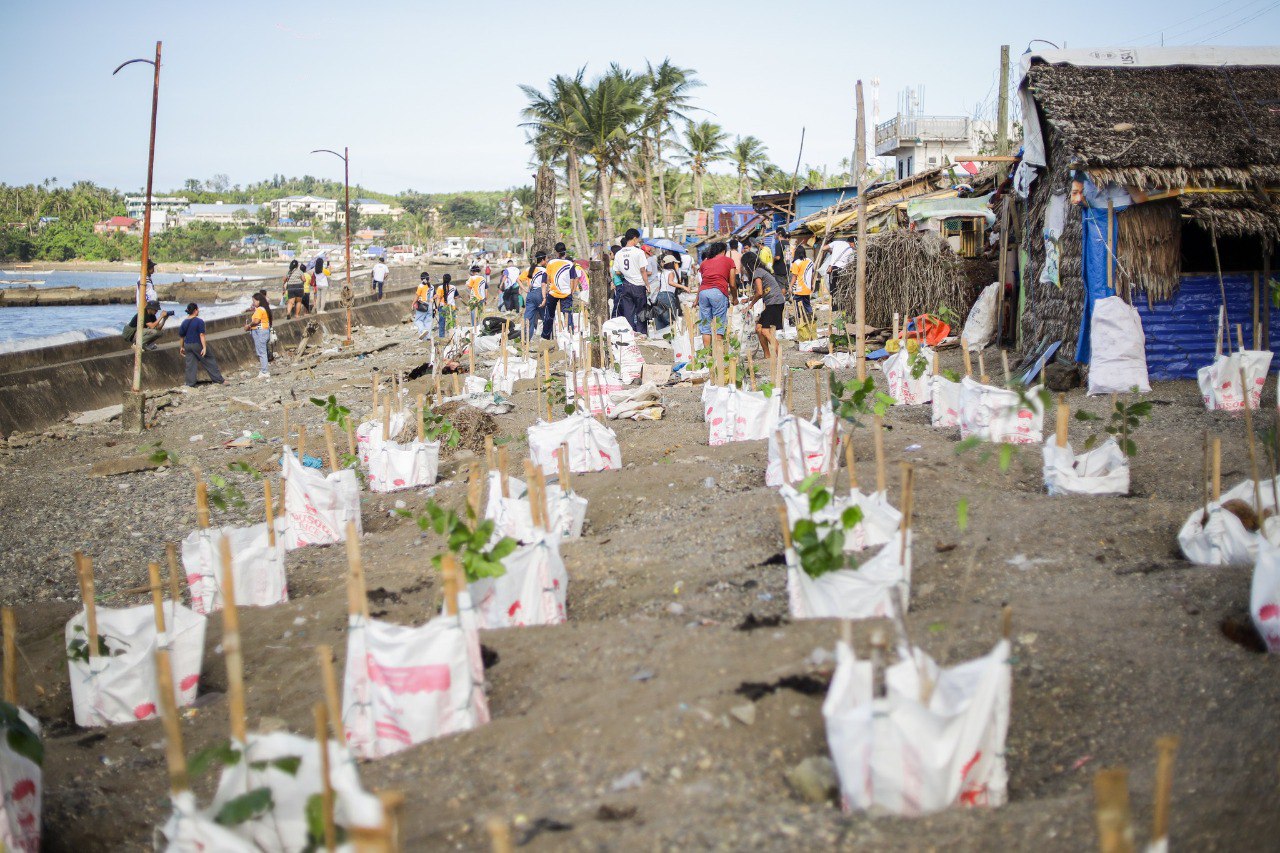
In Garchitorena, nearly 1,500 trees have been planted along the coastal stretch in Barangays I, II, III, and IV. The project uses four native trees: Banaba, Bani (Maruk-barok), Talisay, and Molave. These species were selected for their resilience and effectiveness in shielding communities from typhoon-driven waves and coastal erosion.
As part of its long-term strategy to combat flooding and coastal degradation, the Provincial Government plans to expand the Green Embankment Project to the coastal municipalities of Lagonoy, Caramoan, and Goa, as well as flood-prone communities within the Bicol River Basin, including Baao, Bula, Nabua, and Pili.
DENR-PENRO CamSur OIC and PENR Officer Forester Herleo Pavericio expressed full agency support, noting that green embankments, unlike concrete dikes, actively counter climate change by lowering temperatures, improving air quality, and supporting wildlife habitat.
“Planting alone is not enough. People must maintain and care for these embankments. The communities are the first to benefit, and they must also be the first line of protection,” Pavericio said.
Aksyon Kontra Baha: Engineering resilience in Milaor
In Milaor, the localized Aksyon Kontra Baha Program launched a 5.6-kilometer flood mitigation project targeting recurring inundation in the municipality. The program employs engineering interventions, including dredging, desilting, and clearing of clogged waterways, to restore river flow and prevent overflow during heavy rains and typhoons.
“For many years, our barangay has suffered from severe flooding, especially during strong typhoons. There were times when floodwaters lingered for almost a month, making it difficult for families to access food, water, and necessities. That is why we are deeply grateful for the Aksyon Kontra Baha Program,” said Barangay Captain Benjamin Encinas Jr. of Barangay Flordeliz, Milaor.
Communities and youth at the forefront
For coastal residents of Garchitorena, the project carries particular urgency. Lorleny Alejandro, a local volunteer from Sagrada, described the toll that repeated typhoons have taken on the community. “Every typhoon brings tremendous hardship to people living here. Each time, they lose their livelihoods, their belongings — everything. It becomes a constant cycle. Instead of gradually getting ahead, they are pushed back to zero again and again,” she said.
Alejandro noted that the project will expand forest cover, improve air quality, and provide shade and shelter across 23 barangays in the area, including those on coastal islands.
The youth sector has also stepped up in support of the initiative. Carlo Delos Santos, a student from the Governor Mariano E. Villafuerte Community College in Garchitorena, emphasized that student participation in the project is vital, as they play a key role in educating future generations on the importance of protecting and preserving trees.
"In terms of cleanliness, we will conduct proper waste segregation: separating biodegradable from non-biodegradable waste. To protect the embankment, we will water the plants daily and ensure that no leaves are stripped from them. Most importantly, we must protect the trees, for they will be our greatest ally in the challenges that lie ahead,” he said.

 Provincial Government of Camarines Sur