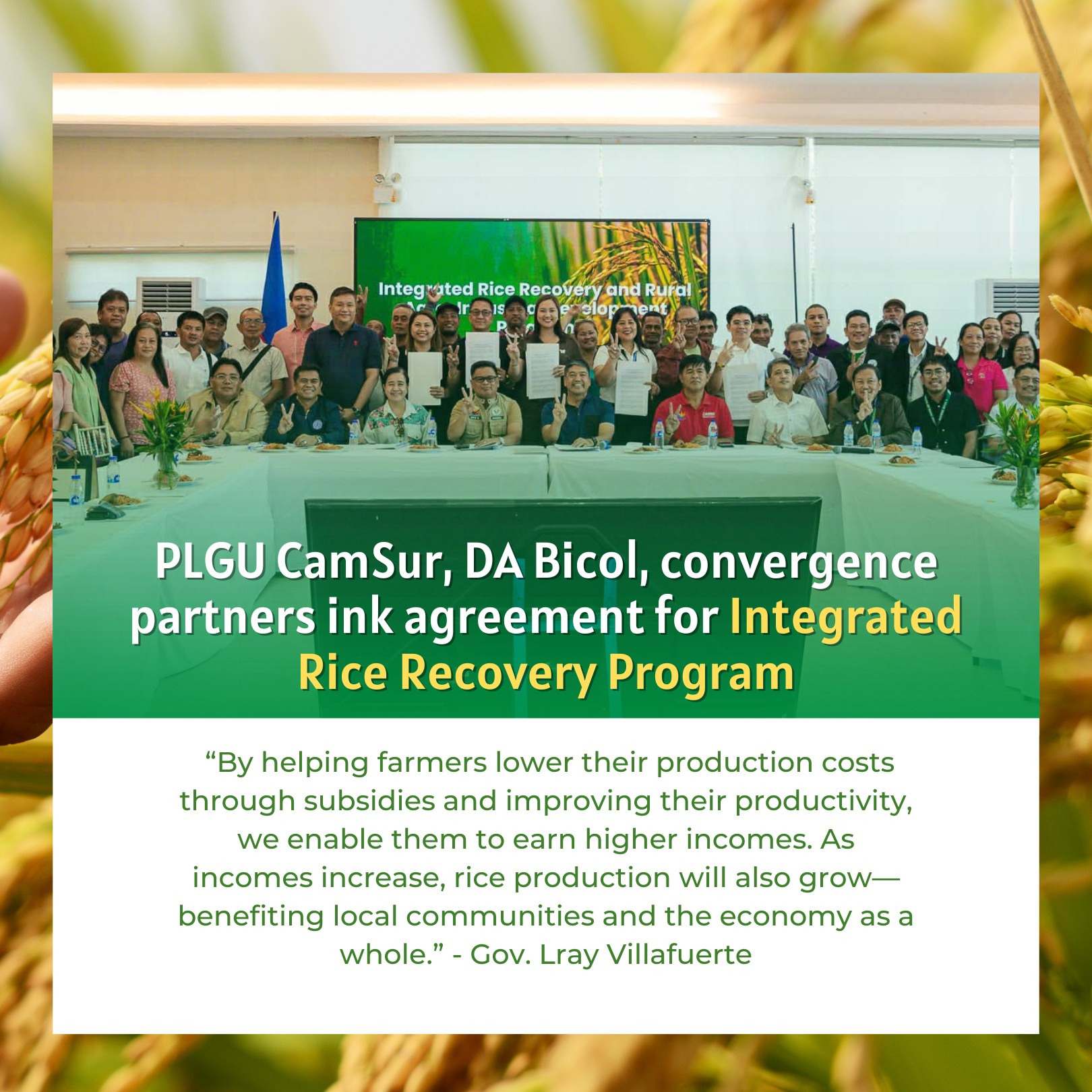
In a major push to strengthen food security and help farmers recover from recurring climate shocks, the Provincial Government of Camarines Sur and the Department of Agriculture Bicol, together with key national agencies, signed a Memorandum of Agreement launching the Integrated Rice Recovery and Rural Agro-Industrial Development Program on March 4, 2026 at the Digital Transformation Center, Capitol Complex, Cadlan, Pili.
The Rice Recovery Program is a convergence-driven initiative designed to address the impacts of recurrent natural disasters and the prolonged use of inorganic agricultural inputs in the province’s rice-producing areas. These challenges have contributed to soil degradation, unstable yields, and income volatility among farmers, increasing their vulnerability to climate-related shocks and limiting access to stronger value chains and risk protection mechanisms.
“This gathering is very important because while we are launching this program in Camarines Sur, its impact can extend far beyond the province and contribute to strengthening the rice program of the Philippines,” said Governor Luis Raymund “Lray” Villafuerte, Jr. during the MOA signing.
The Provincial Government of Camarines Sur will serve as the lead implementing agency, with the Department of Agriculture as co-lead. Convergence partners include the Department of Social Welfare and Development, National Irrigation Administration, Department of Agrarian Reform, Cooperative Development Authority, Department of Labor and Employment, Philippine Crop Insurance Corporation, Technical Education and Skills Development Authority, and the Municipal Local Government Units.
“With the commitment of all our partners, this initiative can truly become a win-win for everyone,” Governor Villafuerte said. “By helping farmers lower their production costs through subsidies and improving their productivity, we enable them to earn higher incomes. As incomes increase, rice production will also grow—benefiting local communities and the economy as a whole.”
The project will initially cover 3,000 hectares across selected rice-producing municipalities in the province, including Minalabac, San Fernando, Milaor, Pamplona, Pasacao, Gainza, Bula, and Pili. These priority areas are flood and typhoon-prone rice clusters where farm laborers and low-income households are most vulnerable to income disruptions.
The governor further explained that, under the convergence program, farmers will receive assistance to help reduce production costs, improve yields, and secure more stable incomes. The initiative will also strengthen their protection against risks such as typhoons and flooding through crop insurance, ensuring greater livelihood security and resilience in the agricultural sector.

 Provincial Government of Camarines Sur