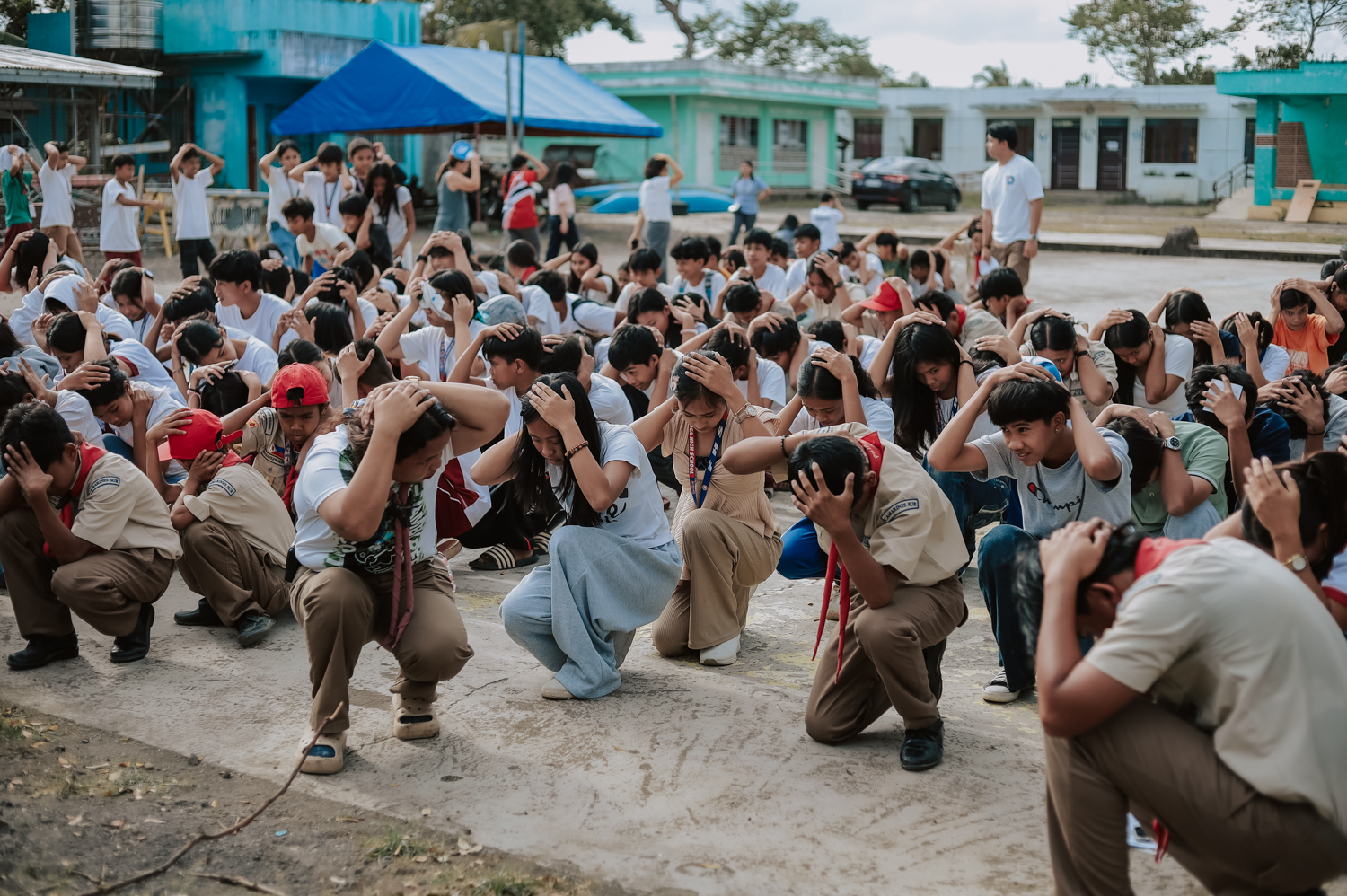
As part of the 1st Quarter National Simultaneous Earthquake Drill (NSED), the Provincial Government of Camarines Sur, through the Environment, Disaster Management, and Emergency Response Office (EDMERO) and the Municipal Disaster Risk Reduction and Management Office (MDRRMO) of Bula, conducted a school-based earthquake drill on March 12, 2026 at Fabrica National High School.
“This activity is vital for student awareness, particularly regarding the protocols they must follow during an earthquake. It is a core part of our disaster preparedness mandate to facilitate these drills in different schools within our jurisdiction. We were impressed by the school’s performance; students were attentive during the symposium and took the simulation exercise seriously,” shared Joseph Atioquia, LDRRMO III of MDRRMO Bula, emphasizing the importance of the drill.
Prior to the drill proper, a symposium on earthquake drill standard practice was held, focusing on legal mandates for disaster drills, the science behind earthquakes, and immediate safety measures. At exactly 3:30 in the afternoon, students and faculty members joined the nationwide simulation of the “duck, cover, and hold” protocol.
“We are very thankful to have been chosen as the pilot school for this activity. I told my colleagues to take this seriously, especially since we have two and three-story buildings. If an unexpected event occurs, we are now familiar with what to do. This activity helps our learners become aware of how to stay safe,” shared William Lopez, School Head of Fabrica National High School.
Lopez added that life-saving skills are just as important as academics. “I always emphasize that we should not only focus on academics. We should also focus on skills that help children survive. If they learn how to save lives, they will carry that knowledge with them long after they graduate. This is a lifetime lesson.”
Yna Manaog, a Grade 10 student and participant in the simulation exercise, highlighted the importance of staying calm should a similar scenario occur in real life.
“It is actually our first time participating in the NSED. It is important to be knowledgeable about earthquake readiness because earthquakes are very dangerous and can be fatal. What stuck with me most is that we should not panic; if we panic, we cannot think clearly.”
During the post-drill evaluation, facilitators noted several areas for improvement, such as the school’s alarm system. They recommended installing a larger bell to ensure it can be heard at the rear of the buildings and suggested an alternative manual alarm system in case of power outages.
To further enhance safety, EDMERO introduced the “Quake Bag” — a specialized emergency bag for school and home use containing first-aid kits, hygiene supplies, and other food and non-food essentials. They also encouraged the school to provide hard hats for students for additional protection against falling debris.
Moreover, the school was directed to establish a formal Disaster Control Group (DCG) and a clear organizational structure. This move aims to streamline the management of drills and actual emergencies to prevent confusion and ensure an organized evacuation process.
The NSED is a nationwide initiative aimed at building a culture of resilience, ensuring that schools, workplaces, and communities are fully prepared for major seismic events.
 Provincial Government of Camarines Sur