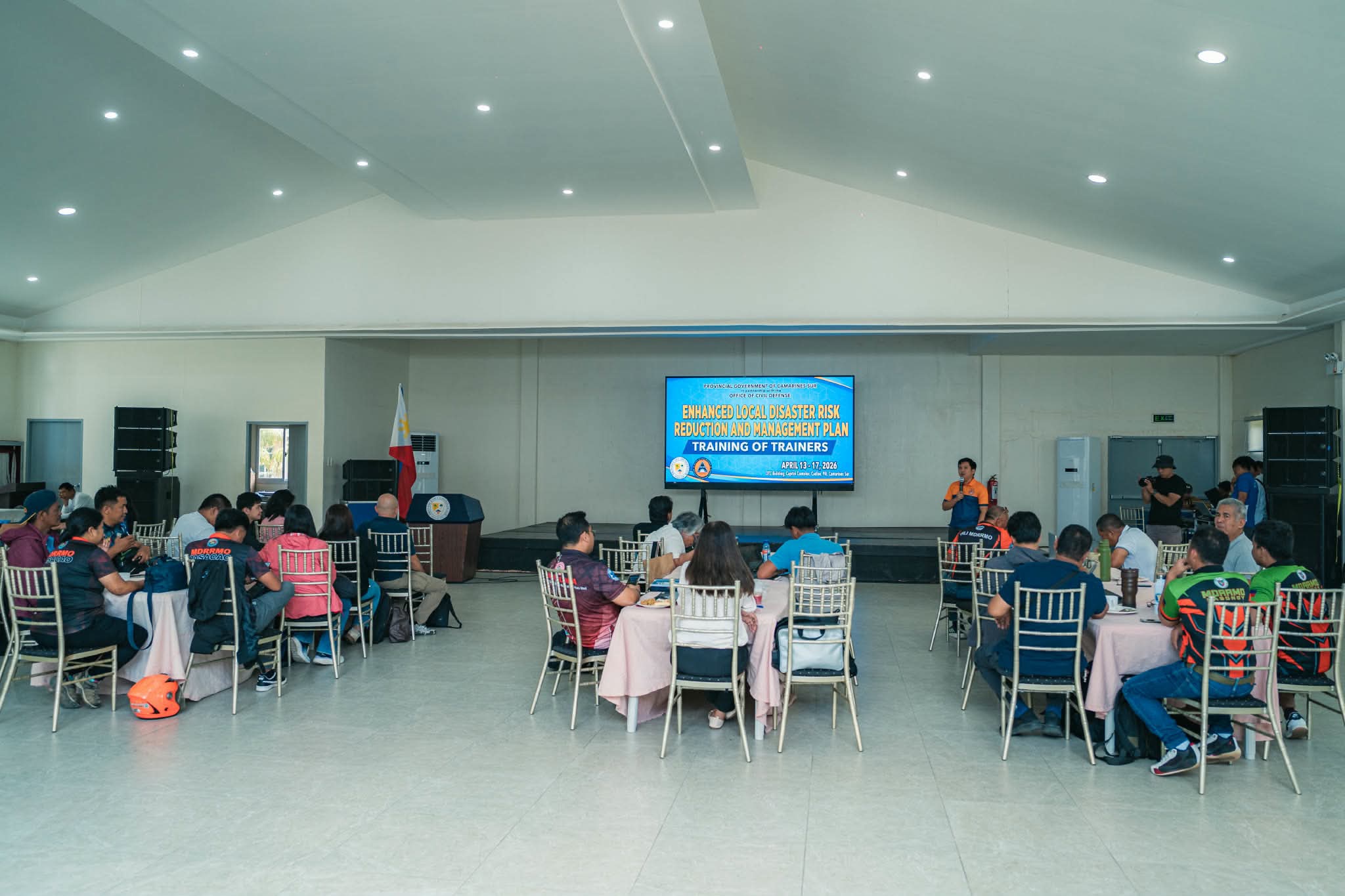
To further strengthen the province’s resilience and disaster preparedness, forty (40) Municipal Disaster Risk Reduction and Management (DRRM) officers and representatives from across Camarines Sur successfully completed a 5-day Enhanced Local DRRM Plan (LDRRMP) Training of Trainers on April 13-17, 2026 at the Digital Transformation Center, Capitol Complex, Cadlan, Pili.
The intensive program, led by the Provincial Government of Camarines Sur through the Environment, Disaster Management, and Emergency Response Office (EDMERO), in partnership with the Office of Civil Defense (OCD) 5, aimed to elevate the planning standards of the local government units.
Francis Jerard Licup, Alternate PIO of the OCD 5, emphasized the impact of the training program. “Galing at pinag-usapan ito sa National DRRM Council. Dito, ini-enhance natin yung pagpaplano sa local DRRM para maging mas epektibo, komprehensibo, at makatulong talaga with regards sa DRRM measures lalo na kapag may malalakas na bagyo, lindol, at iba pa, para mas maka-cope up at maka-recover tayo. Itong enhanced module natin ay hindi lang para ngayong taon, kundi sa mga susunod pa. This is a long-term plan,” he said.
Throughout the training, participants underwent rigorous modules designed to sharpen their strategic capabilities, including the fundamentals and framework of the LDRRMP, situation analysis, risk assessment and tools, planning and budgeting, policy alignment, monitoring and evaluation, post-LDRRMP development activities, and specialized facilitation guides, among others.
Licup further highlighted the importance of localized strategies, noting that the enhanced plans must be tailor-fit to the specific hazards faced by each LGU. By ensuring these plans are precise, the outputs contribute significantly to national, regional, and even international disaster resilience goals.
Nel Gabriel Arroyo, Planning and Research Section Chief of MDRRMO Buhi, and one of the participants, shared, “This is very important kasi dito [sa plan] nakalagay kung ano ang mga kailangang gawin, ano ang mga hindi pa nagagawa, ano ang mga bagong actions na kailangang i-address. Dahil enhanced na, dapat evidence-based LDRRMP na. Kailangan natin ng CDRA or Climate Disaster Risk Assessment. ‘Yung mga decisions natin, lahat ng gagawing plans, programs, and activities, dapat naka-base na. Dapat mayroong nagsasabi na kailangan talaga natin itong gawin scientifically.”
Arroyo added that the ultimate vision of the training is simple yet profound. “Isa lang ang impact nito— resilient community. ‘Yun ang pinakagusto nating mangyari, maging resilient ang Filipino communities.”
As a newly minted trainer, Arroyo described the experience as empowering. “Very uplifting! Although nakapag-training na ako dati ng LDRRMP, pero as a normal participant lang. But this time, uplifted na ang spirit namin as trainers. Ire-ready na namin ang mga sarili namin kasi pagdating sa mga LGUs, kami na mismo ang magte-train sa kanila para makapag-produce ng Enhanced LDRRMP.”
Having mastered these modules, the participants are now recognized as trainers. They are urged to lead the cascading of this vital knowledge within their respective LGUs and serve as key partners of the OCD and the Provincial Government in facilitating future trainings across the Bicol region.
With a stronger, more technical pool of experts on the ground, CamSur continues to lead the way in proactive governance— ensuring that every LGU is not just prepared for the challenges but empowered to overcome them.
 Provincial Government of Camarines Sur