For decades, the communities along the Waras River in Sta. Elena Baras knew the annual rhythm all too well: as storm clouds gathered over the mountains of Camarines Sur, families would look anxiously at the swelling banks of the river and begin moving their most precious belongings to higher ground. The floods always came.
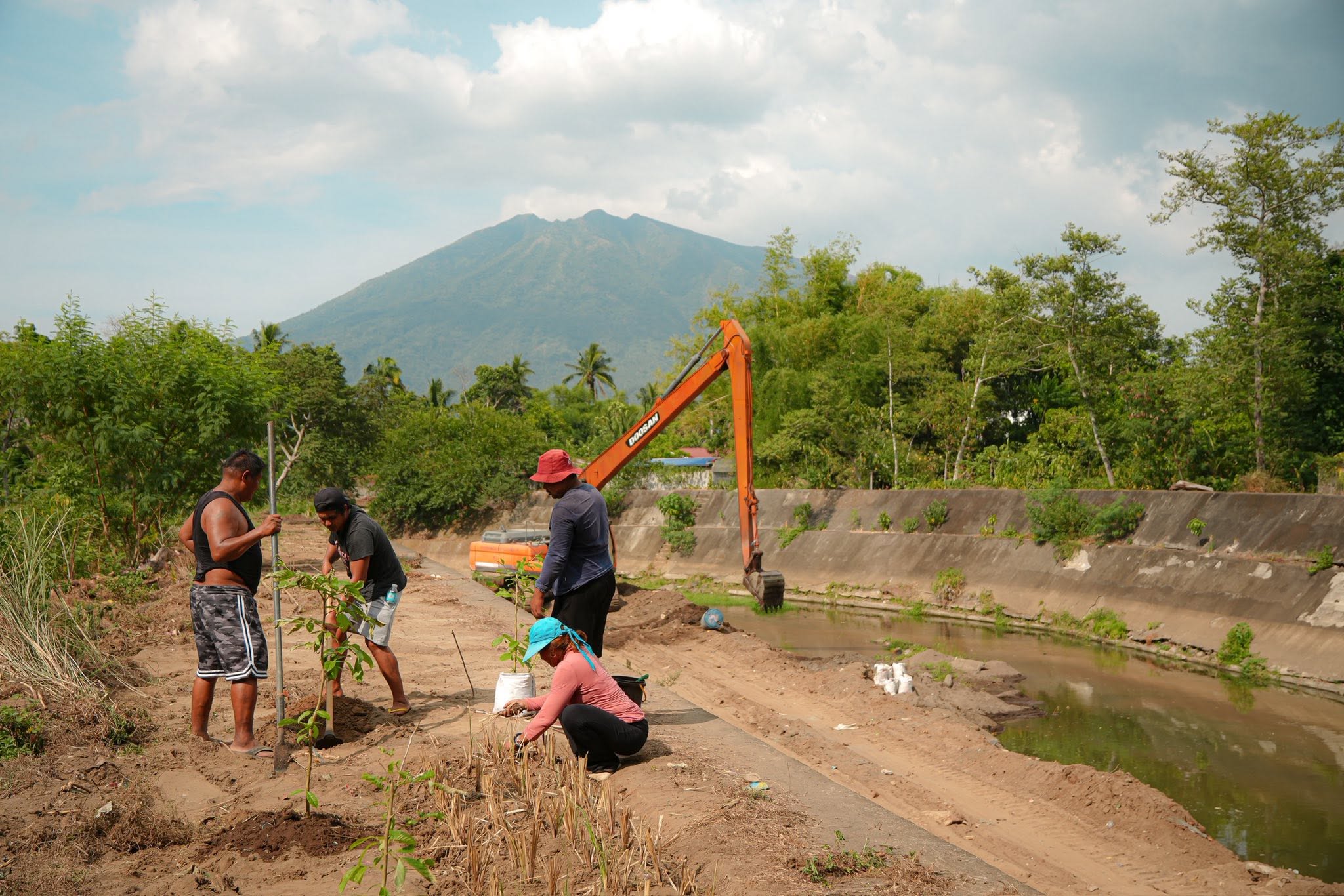
Now, along those same banks, something new is taking root — literally. Rows of banaba trees and clumps of vetiver grass stretch along the riverbank, their roots anchoring soil that used to wash away with every heavy rain. Below the waterline, dredging equipment has been clearing years of accumulated silt, restoring the river's natural capacity to carry away the waters that once invaded homes and paralyzed communities.
This is the Green Embankment and Waterways Dredging Project of the Provincial Government of Camarines Sur, a flagship component of its broader Flood Mitigation Program, and one of the most visible expressions of the province's commitment to building climate resilience from the ground up.
A river that defines a community
The Waras River is more than a body of water to the residents of Sta. Elena Baras. Positioned at the strategic boundary where the municipalities of Nabua and Baao meet the City of Iriga, the river corridor functions as a vital artery of daily life and a route for residents, travelers, and motorists who depend on it to connect with the rest of Camarines Sur.
The importance of this corridor was thrown into sharp relief when the Waras Bridge was damaged by a previous storm. In the aftermath, the road running alongside the river became one of the primary alternative access routes for affected communities. What might have seemed like a secondary road proved, in that crisis, to be a lifeline. The experience underscored a hard truth: the physical and infrastructural health of this river zone is inseparable from the safety and mobility of thousands of Bicolanos.
For years, however, the river had been suffering in silence. Silt and sediment accumulated on the riverbed, gradually reducing its capacity to channel water efficiently. Without proper embankment, each flood season brought not just water, but erosion, stripping away the soil on which homes and farmlands were built. Communities in Sta. Elena Baras and neighboring barangays bore the brunt of these recurring disasters, often with little recourse.
Dredging the path to resilience
The Provincial Government's intervention at the Waras River targets these problems at their root. Through systematic waterways dredging, the accumulated silt clogging the riverbed is being excavated and removed, restoring the waterway's natural depth and flow velocity. The improved hydraulic capacity means the river can now accommodate significantly greater volumes of water before overflow occurs, reducing the risk that even moderate to heavy rainfall will translate into flooding for nearby homes.
But the project goes beyond simply deepening the river. The green embankment component addresses what happens at the water's edge: through strategic planting of banaba trees and vetiver grass along the riverbanks, the project is engineering a living, self-reinforcing barrier against erosion and overflow.
Vetiver grass, chosen for its extraordinarily deep root system, which can penetrate several meters into the soil, serves as a natural soil anchor. Unlike conventional concrete embankments that can crack and fail under sustained hydraulic pressure, vetiver's fibrous root network flexes with the natural movement of water while holding the bank firmly in place. Banaba trees, prized throughout Southeast Asia for their resilience and ecological value, complement this by absorbing excess moisture from the soil and contributing shade that moderates soil temperature, slowing evaporation and further stabilizing the bank.
"Before, even moderate storms would leave our community submerged and force families to evacuate to higher ground. Through the Green Embankment and Waterways Dredging Project of the Provincial Government of Camarines Sur, our river is being restored, and our community is gaining stronger protection against flooding. This program is not only helping prevent erosion and improve water flow; it is giving hope and security to the people of Santa Elena and nearby communities," said Barangay Captain Alvin Bernejo of Sta. Elena Baras, Nabua.
More than concrete: A green promise
What distinguishes Camarines Sur’s approach from purely structural flood-control measures is its emphasis on ecological integration. Across the Philippines, hard engineering solutions — concrete walls, steel revetments — have often addressed one problem while creating others: destroying riparian ecosystems, disrupting fish habitats, and failing to account for the dynamic nature of river systems over time.
The green embankment model, by contrast, works with the river's ecology rather than against it. The planted species are not ornamental; they are functional components of a living flood-management system. As banaba and vetiver mature, their effectiveness increases: root systems deepen, canopy coverage expands, and the embankment becomes increasingly self-sustaining. The investment compounds over time, delivering growing returns in resilience for generations of residents.
For barangay residents who have spent years watching precious topsoil wash into the river during every typhoon, the sight of young trees taking hold along the banks carries a meaning that goes beyond technical specifications. It is evidence that someone is thinking not just about the next storm season, but about the long-term relationship between their community and the river they live beside.
"Planting trees along the riverbanks and deepening the waterways are simple actions with a lasting impact. For years, our barangay endured severe flooding whenever strong typhoons came. Now, with these ongoing efforts, we are seeing a future where our community is safer, our environment is protected, and our people can live with greater peace of mind," shared Felicito Estoy, a resident of Sta. Elena Baras, Nabua.
Part of a provincewide strategy
The Waras River site is not an isolated project. The Provincial Government of Camarines Sur has been systematically rolling out its Flood Mitigation Program across the province's most vulnerable waterways and communities.
Each implementation site is selected based on assessed vulnerability: communities that have experienced repeated flooding events, areas where river overflow has resulted in significant displacement or economic loss, and corridors where infrastructure disruption during flood events creates cascading effects on mobility and access to services. The Waras River corridor, with its intersection of human settlement, critical infrastructure, and recurring flood history, exemplified exactly the kind of site the program was designed to address.
The program also represents a model of climate adaptation that is increasingly recognized as essential in a country that consistently ranks among the world's most vulnerable to natural disasters. The Philippines' archipelagic geography and position in the Pacific typhoon belt mean that no amount of infrastructure investment can entirely eliminate flood risk, but strategic, ecology-informed interventions can significantly reduce both the frequency and severity of flood impacts on communities.
Rebuilding trust, one embankment at a time
Perhaps the most significant impact of projects like the Waras River intervention is not measured in cubic meters of sediment removed or linear meters of embankment planted. It is measured in something harder to quantify: the restoration of a sense of security among communities that have, for too long, felt abandoned to the annual flood cycle.
When Barangay Captain Bernejo speaks of the project giving hope and security to the people of Santa Elena, he is articulating something that no engineering study can fully capture. Flood trauma is real and cumulative. Families who have evacuated repeatedly, who have watched their possessions float away, who have rebuilt only to see their efforts washed out again, carry a psychological burden alongside the material one. A visible, ongoing government investment in their safety is itself a form of relief.
For the Provincial Government of Camarines Sur, the Flood Mitigation Program, executed through initiatives like the Green Embankment and Waterways Dredging Project, represents a concrete commitment to translating policy into tangible community benefit. The dredgers and tree-planters working along the Waras River are not simply completing a project scope. They are building a more resilient province— one where families living beside rivers can face the next typhoon season with genuine confidence that the banks will hold.
 Provincial Government of Camarines Sur