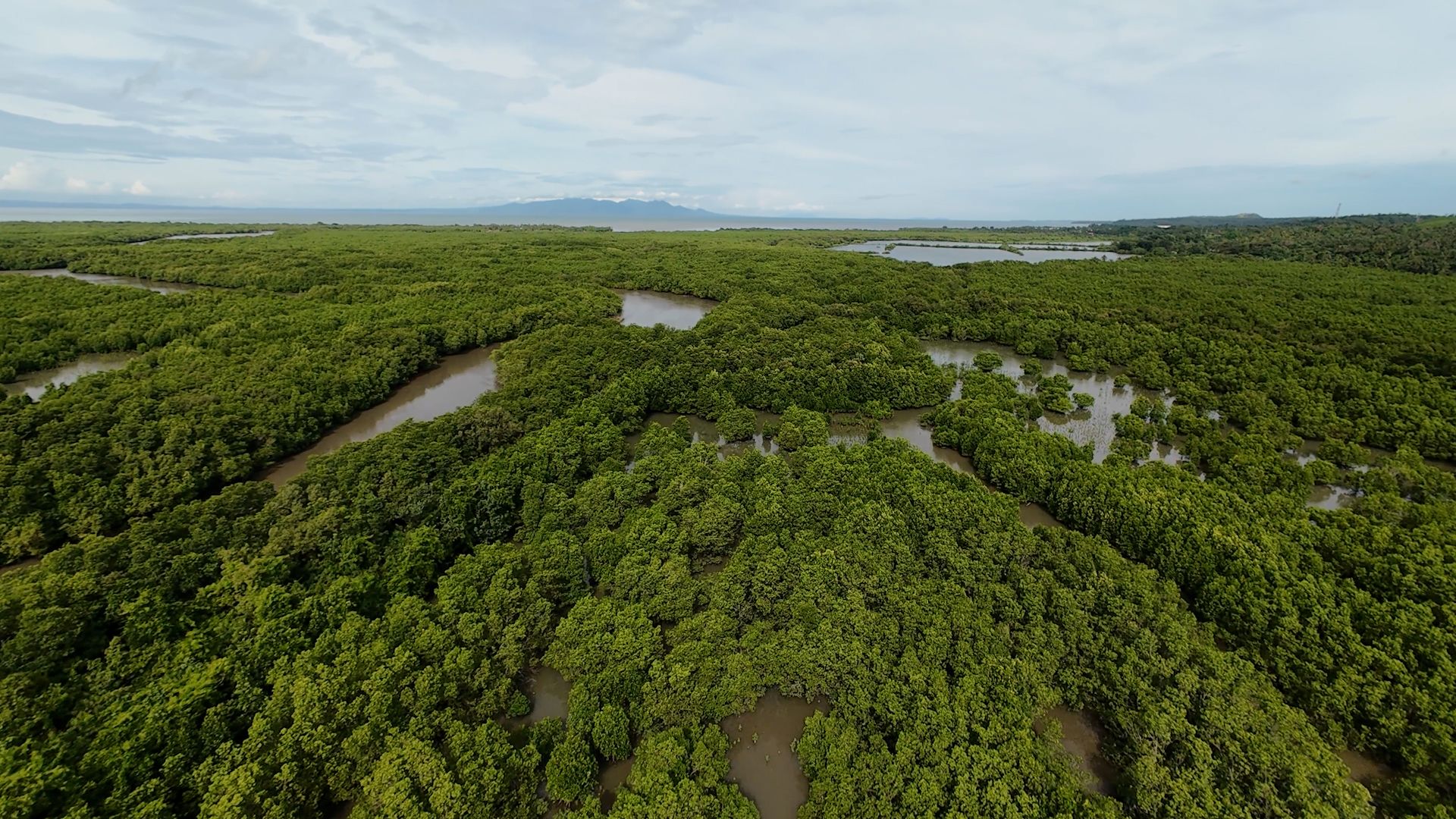
Tinambac, a coastal town long familiar with the hardships of poverty and storms, has transformed its battered shoreline into one of the most ambitious ecological restoration programs in Camarines Sur through the El Verde Program.
A landscape once defined by tidal mudflats and abandoned fishponds—symbols of a struggling local economy—is now anchored by a vast, living wall of mangroves.
This plantation is the product of years of community labor and an unwavering belief that restoring the coastline could restore the lives of the people who depend on it. Today, it draws a richness of marine life back to the waters and has given rise to entirely new livelihoods that did not exist a generation ago.
As of 2025, the mangrove plantation had expanded to 376.3 hectares, with 130.3 hectares consisting of natural stand mangroves. The plantation covers six barangays, namely, Old Caaluan, New Caaluan, Mananao, Sta. Cruz, Bagacay, and Bolaobalite.
Adversity before the greenery
Before the mangroves took root, life for the locals was a constant struggle for both survival and safety. Josefino “Kuya Kikoy” Barrameda, a 52-year-old resident of Barangay Old Caaluan, vividly remembers an era of scarcity where aquatic life was nearly non-existent, and the land offered nothing but rows of empty fishponds.
“Kaidto, grabe ang pagtios kang mga tawo. Mayo ka pong madakop na an-it diyan. Mayo man diyan mga sulong. Mayo man diyan kahiwasan ning mangroves ta puro fishpond,” he recalled.
For the people living in areas like Old Caaluan, conditions were extremely difficult, and the population had dwindled to just fourteen households.
Beyond the lack of food, the absence of a natural coastal barrier meant that families lived in constant fear during typhoon season. Danilo Base, a 60-year-old resident of Barangay Pag-asa, described the terror of past storms. He explained, “Pag grabeng bagyo kadto, tig-aabot digdi sa enterong kabatangan. Naghaharali kami digdi, nagtatarago kami kung sain na mga bulod. Walat mi diyan ang mga harong mi.”
Strong waves and high storm surges frequently threatened to wash away their homes entirely. Fishermen even lost their boats to calamities—stripped of their only means of livelihood in a matter of hours.
Provincial Government's green initiative
The narrative began to change in 2011 when the Provincial Government strengthened mangrove protection through the Provincial Ordinance No. 028, placing 4,747.54 hectares of mangrove areas under conservation. As part of this initiative, a 246-hectare mangrove conservation area was established in Tinambac, where 12 million coastal and upland trees were planted within the first year.
Of the 39 mangrove species found in the Philippines, 29 thrive within the Tinambac Mangrove Plantation, making it the largest mangrove plantation area in the province.
That same year also saw the birth of the El Verde Program in Tinambac. Kuya Kikoy was appointed as a caretaker, leading the community through the painstaking work of restoration.
Restoring livelihoods and new opportunities
As the mangroves matured, the ecosystem began to provide for the people once again. Fisherfolks found themselves surrounded by an abundance they had never known in recent memory. “Gulpi na pong nakukua. Su an-it, su darakulang sira, su aliso, su balanak. Nagsakay [ngani ako sa bangka] sarong banggi, huna ko uran, ito palan balanak,” described Kuya Kikoy.
The restoration also created new forms of livelihoods that rarely existed in the area before, such as pagpunaw (gleaning), pagbobo (crab fishing), and pagpuwag nin hamis (honey farming).
Honey farming, in particular, has become a significant source of income despite the risk of bee stings. Because the mangroves attract more honeybees during the hot season, farmers like 28-year-old Marvin Arejola from Barangay Old Caaluan have seen a major boost in their finances.
“Pag nagbuburak na po ang mga bakawan, igwa na po kaming nakukuang honey. Importante po ini sakuya ta minsan halos oras lang, minsan nagi-income akong 2,000 or 1,500. Minsan pag dakol-dakol, nakaka-3,000. Sa pagpuwag po kaya, madali ang kwarta. Makakua ka sanang duwang harong [ning pukyutan], siguradong may 2,000 kana,” shared Arejola.
Another farmer, Joseph Abarientos, a 41-year-old resident of the same barangay, noted that before the mangroves were planted, honeybees were rare. Now, with his daily income ranging from ₱2,700 to ₱3,000—selling honey at ₱150 per bottle—he is able to secure his family's future and send his children to school.
He expressed his gratitude, saying, “Dahil po sa pagkabuhay ko digdi sa Old Caaluan, an sakong aki napaeskwela ko man po. Pasalamat po akong maray ki Gov. sa pagpatanom kaning mga mangroves ta nadagdagan po si samuyang pagkabuhay.”
A new sense of security
Perhaps the most critical result of the program is that the fear of the sea has slowly faded. The mangrove plantations now serve as a frontline of climate resilience, acting as a natural defense against calamities.
Danilo Base explained that even during storms, the water no longer reaches the residential areas because the mangroves are so vast and thick. He noted, “Dai na kami natatakot ta may nakakasagang na sa alon. Maski ngani nagpapaapod ang barangay na mag-evacuate, dai na kami nage-evacuate ta may nakakasagang naman. Tiwala na kami sa mga bakawan. Safe na ang pamilya ko sagkod ang mga pagtaraid ko.”
Beyond protecting homes, the mangroves even protect the tools of their trade. Base mentioned that he now uses the shade and dense root structure of the mangrove forest to keep his fishing boat safe and intact from the wind and waves.
To support residents as they shifted their focus to conservation, the Provincial Government complemented the planting program with a Food for Work initiative. Under this scheme, those who planted mangroves received sacks of rice proportional to the area they covered.
Sherly Brazal, a 60-year-old resident of New Caaluan, shared how significant the program has been for her family. “Nagpuon po kaming magtaranom kang 2011. Dakulang bagay samuya, dakol ang nakinabang. Gulping [nakaresibeng] bagas. Orogma po ang tao ta may panibago na naman na halat-halaton.” Her family alone received 60 sacks of rice after planting three hectares, which secured their food supply for a long period.
“Gulpi po ang nagbago ang buhay kaya dakulang tabang talaga. Pag nababayadan na kami [ning bagas], syempre haloy naman kaming matipon ning bagas ta may stock naman kami. Haros panira nalang ang [hanapon]. Ang panira digdi libre man kung mahigos ka lang. Yaon na po digdi ang gabos na panira—an-it, kasag, punaw, tahong, pasayan, balaw,” she added.
With food supplies secured and the sea providing generously, Brazal is beyond grateful that their daily consumption needs now come freely from the mangrove ecosystem itself.
A sustainable future under visionary leadership
The success of the El Verde Movement is a testament to the power of community action supported by a strong government vision. What was once a series of abandoned fishponds is now a thriving ecological sanctuary that provides food, income, and safety for the people of Tinambac.
This transformation was made possible through the unwavering commitment and initiative of the Provincial Government of Camarines Sur, under the visionary leadership of Governor Lray Villafuerte.
By prioritizing environmental restoration alongside the welfare of coastal communities, the program has turned an ecological crisis into a success story of resilience, abundance, and hope. Through this initiative, the locals in Camarines Sur now have not only a shield against the storms of today, but a solid foundation for the growth of tomorrow and the generations to come.


 Provincial Government of Camarines Sur