Aiming to build a generation of disaster-ready leaders, the Provincial Government of Camarines Sur, through the Environment, Disaster Management, and Emergency Response Office (EDMERO), successfully held the Future-Proof CamSur: Youth Camp 2026 on July 24–25, 2026, at the Eco Village, Capitol Complex, Cadlan, Pili. The two-day camp brought together 169 youth leaders and representatives from schools, civic organizations, and volunteer groups across the province, anchored on the theme, “Prepared Youth, Resilient Communities, Stronger CamSur.”
The event is part of the month-long CamSur Resilience Festival, held in observance of National Disaster Resilience Month (NDRM). It reaffirmed the Provincial Government's commitment to cultivating a culture of preparedness that begins not with infrastructure or policy alone, but with people — particularly the youth, who are increasingly recognized as vital partners in community-based disaster risk reduction and management (DRRM).
Participants came from a wide network of organizations, including Caceres ERG R5, Caritas, EVYCA Milaor, EVYCA Pili, EVYCA Tigaon, Gryphon Bicol R5, Iyagan National High School, Partido National High School, the Youth Development Office (YDO) of Canaman, and World Vision.
“Saro sa mga pinaka-importanteng nanudan ko sa laog ning duwang aldaw na ini is kung pano po mag-assess nin sarong incident or disaster, pano po siya paghandaan,” shared Jeremy Paul Madrazo, 19, a member of Caritas, after the two-day interactive learning camp. He also emphasized the importance of involving the youth in disaster resilience activities, noting that they will soon lead the next generation and echoing the famous line, “Kabataan ang Pag-asa ng Bayan.”
Rather than relying on lectures alone, the camp was designed around five interactive learning stations that immersed participants in the full cycle of DRRM.
At the Prevention and Mitigation station, participants explored the link between environmental protection and disaster resilience, learning proper waste management and environmental stewardship practices. This laid the groundwork for the Preparedness station, where youth leaders learned to monitor typhoons and track weather patterns, assemble emergency kits and Go Bags, and execute safe, orderly evacuation procedures.
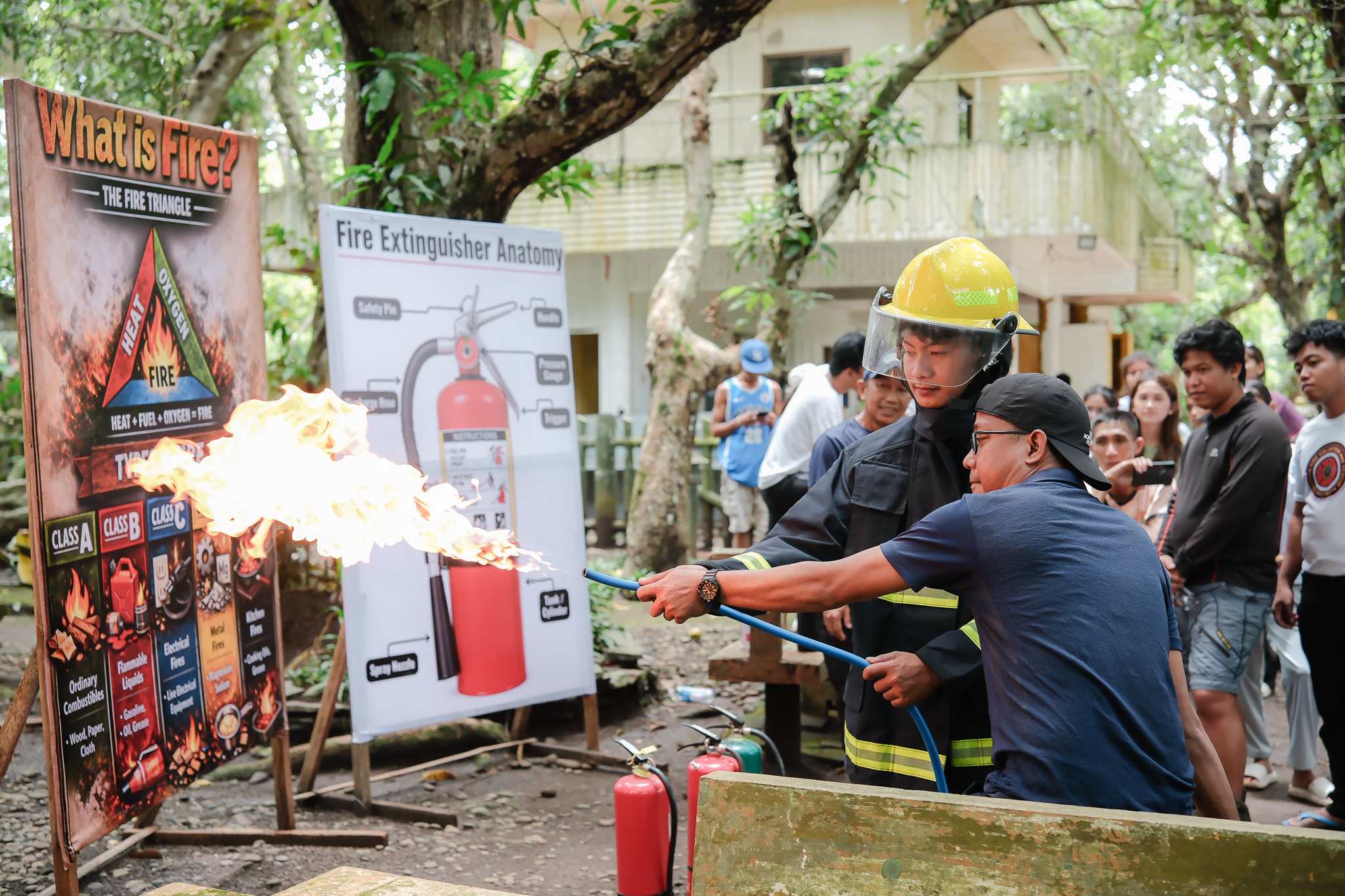
From there, the camp moved into its most hands-on phase at the Response station, which covered fire classification and suppression techniques, bucket relay operations, and the proper use of fire extinguishers. Participants also practiced hands-only CPR, splinting and bandaging, basic search-and-rescue methods, and rope rescue techniques — skills that translate directly into life-saving action during emergencies.
The learning journey then turned to the aftermath of disaster at the Rehabilitation and Recovery station, where participants examined how communities assess damage, document losses, and prioritize recovery efforts, while learning the principles of "Building Back Better" to create more resilient housing and neighborhoods.
Rounding out the five stations, the Incident Management introduced participants to the Incident Management Team (IMT) and Emergency Operations Center (EOC) structure and the response cluster system, culminating in a tabletop emergency simulation exercise that tested their decision-making under pressure.
As an active member of a volunteer organization, Madrazo also shared which station left the greatest impact on him.
“Ang pinaka-highlight po sakuya itong station 5 kasi ang nahihiling ta lang po during the disaster is itong mga nagreresponde na. Ito pong dai ta nahihiling behind the scenes, iyo na po tong mga RO (Responsible Office), sinda mayor, si mga yaon po sa laog kang municipality, [kung] pano po sinda naghahanda bago [pa mag-abot] ang typhoon. Iyo po ito ang pinakamagayon adalan bilang mga mamamayan na dapat iniisip ta din po si mga gignigibo kang mga ahensya o opisyales.”
Every lesson learned across the five stations came full circle in the camp's culminating activity: a disaster simulation exercise in which participants responded to a typhoon scenario involving injured victims. Applying the skills they had built throughout the two days — from first aid to search-and-rescue to incident coordination — the youth leaders worked as teams to assess, respond, and manage a simulated crisis, transforming classroom knowledge into practical, real-world capability.
One memorable "plot twist," as Madrazo described it, came on the first night of the camp, when an unexpected heavy downpour inadvertently placed participants in the very kind of situation they were there to prepare for.
“Kami ngani po si tigti-train na pano kami mag-rescue sa mga taong nasalanta, and kasubanggi kami man po palan ma-rescue kang si sadiri mi ta grabe po si uran, dai mi po inaasahan. Mga arog po katong pangyayari mapapaghandaan ta po sa mga arog kaining activity,” he recalled, underscoring that experiences like these reinforce the value of interactive learning, where disaster response skills are best learned through firsthand practice.
The Future-Proof CamSur: Youth Camp 2026 is more than a training event — it is an investment in the province's long-term resilience. By equipping young leaders with practical DRRM skills, fostering volunteerism, and encouraging active community engagement, EDMERO and the Provincial Government are cultivating a new generation of Camarinenses who are not only prepared to protect themselves, but empowered to lead others in times of crisis.
 Provincial Government of Camarines Sur